
Introduction
Author and the Recipients:
Ephesians was written by the apostle Paul. The best argument against Pauline authorship is rooted in Paul’s seeming unawareness of the Ephesian church despite spending three years in Ephesus; however, this can be explained by Paul’s absence from the Ephesian church for nearly seven years between his time there and him writing the letter.
Further, a text critical issue is present in the first verse. In a decent sampling of early manuscripts, “in Ephesus” is omitted.1 However, the omission in these manuscripts is unlikely original because of a broader distribution of “in Ephesus” in manuscripts and the text makes little to no sense without the place name. In the wake of this, some have claimed this text is actually the missing letter to the Laodiceans, but no ancient tradition supports this claim. More likely, Ephesians was written to the Ephesian church, and was after passed to other churches.2 This points to one of the greatest features of the book of Ephesians; since Ephesians has a certain level of anonymity to the book, it stands as a broad and practical word for all Christians. This letter stands beyond unique issues facing a single church and speak to issues affecting all churches and all Christians.
Dating of the Letter:
Closely connected to authorship is the time when Paul authored the letter. Paul mentions his imprisonment in Ephesians which makes best sense to be his imprisonment after his time in Ephesus. This imprisonment can be seen in Acts 24 and following, particularly during his time in Rome. Paul wrote this around the same time as Colossians and Philemon in AD 62.3
Why write Ephesians?
First, idolatry was rampant within the pagan culture of Ephesus. Worship of the goddess of fertility, Diana or Artemis, can be attested to in Acts 19 and further research of the city of Ephesus bears this out. Closely relegated, worship of the imperial family also remained high. During this time, the Roman Empire was still new, and power was being consolidated to Emperor Caesar Augustus and his son Tiberius Caesar. Rituals and festivals would be celebrated on the calendar fixed on the birth of Augustus meaning religious worship was set up under the terms of Augustus’ name.4 The structuring of religious practice around the imperium was well accepted by the Asian populace and further shaped the way the world related “to the ancient cosmological myths that featured the traditional gods.”5
Second, the Ephesians had internal issues. Christianity and Judaism was distinct yet confused, and Paul’s absence brought moral decline and declining morale.6 The letter addresses particular moral issues such as idolatry, greed, and sexual immorality. These Christians also suffered great persecution (see 2 Timothy). Paul is consistently calling for the Ephesians to have courage and to be unified. “Christians in Ephesus needed to work together harmoniously to bear an effective witness to the inimical powers that their efforts to frustrated God’s work were doomed to failure.”7
The Letter’s Structure:
The letter can be seen in two main parts: First, Paul’s prayers for unity and thanksgiving and descriptions of God’s power. Second, a series of admonitions of how to live unified, thankful, and in light God’s power and blessing. However, Paul is often unplanned in his writing and can move from topic to topic freely.
Key Doctrine:
Paul’s letter stresses many of the core principles of Christian theology. Merkel highlights five main categories: the plan of God, union with Christ, walking according to the Spirt, unity in the church, and spiritual warfare.9 First, Paul describes God’s plan as unifying, salvific, calling, and prayer. Unity is found in Christ. God’s plan in salvation stretches before the foundation of the earth by the means of election, redemption, adoption, sealing in the Spirit, and regenerating. God calls Paul to deliver the gospel to the gentiles. Prayer is the means by which we stay on target to reach the goal of the will of God. Then, we witness unity through Christ—both his place in glory and through his sacrifice. As Merkle notes, “It is by being united to him in faith by the Spirit, dying, suffering, rising, and glorying with him, having been predestined and redeemed in him, being identified with his realm, and being incorporated into his people that believers enjoy the manifold grace of God.”10 Further, Christians have an obligation to walk in light of the gospel—walk in the Spirit. The Christian’s new life finds its source in the Spirit not in a changed lifestyle.11 Continuing, the church having been saved and protected, is unified in Christ. In the church, new humanity is possible through the reconciliation with Christ.12 Finally, we are provided armor through the gospel, Spirit, and sacrifice of Christ to fend of the attacks of the enemy. The armor we receive is not an offensive weapon but defensive, so that we may prevail against the great temptations and acts of the enemy.
Ephesians 1:1-2
Outline and Translation:
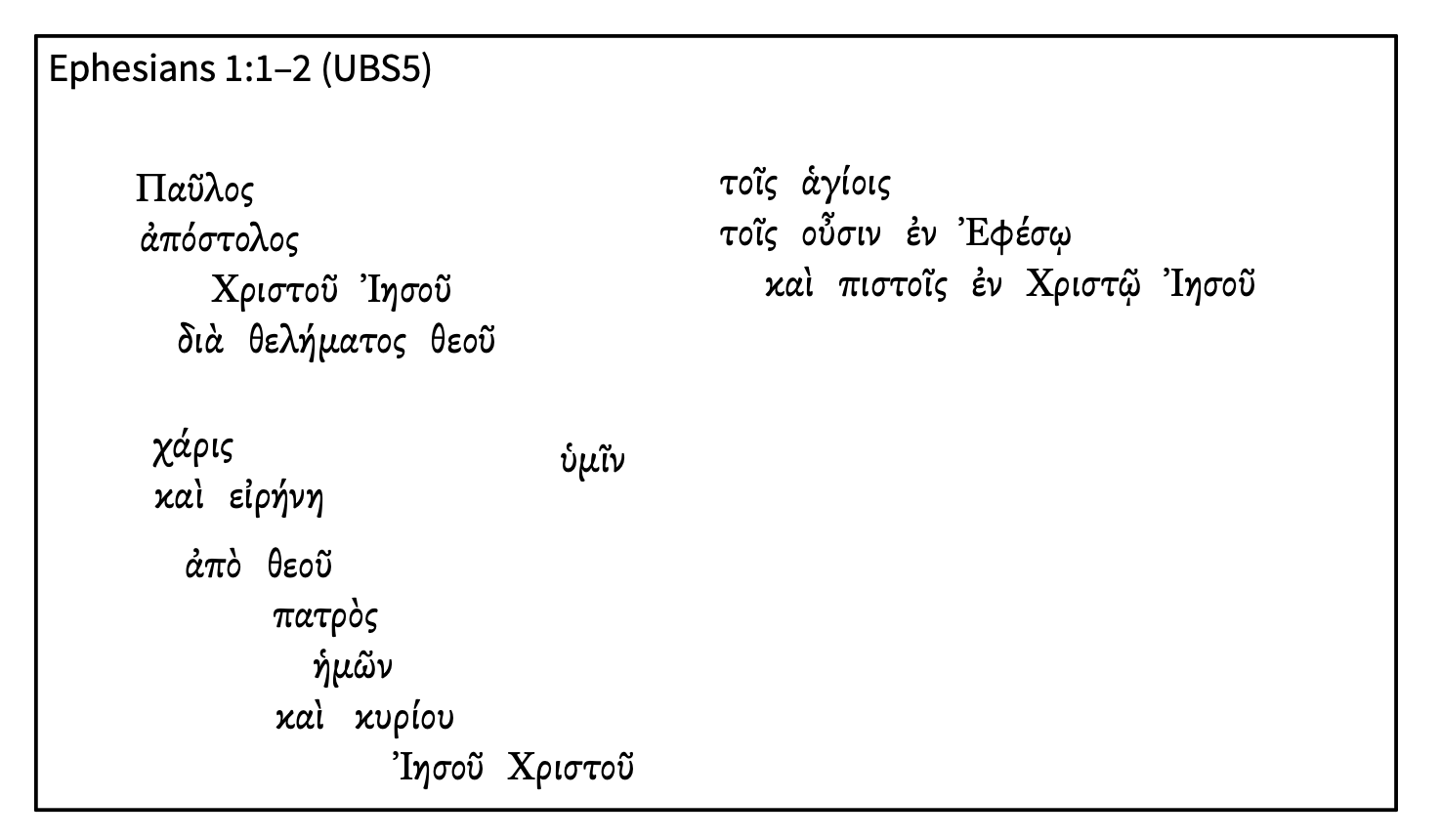
Paul, apostle of Christ Jesus through the will of God, to the saints to the ones being in Ephesus and faithful/believing in Christ Jesus, grace to you and peace from God our Father and the Lord Jesus Christ.
Grammatical Analysis:
1 Παῦλος ἀπόστολος Χριστοῦ Ἰησοῦ διὰ θελήματος θεοῦ τοῖς ἁγίοις τοῖς οὖσιν ἐν Ἐφέσῳ καὶ πιστοῖς ἐν Χριστῷ Ἰησοῦ,
Παῦλος ἀπόστολος Χριστοῦ Ἰησοῦ διὰ θελήματος θεοῦ Παῦλος NMS “Paul,” ἀπόστολος, ου, ὁ NMS “apostle” apposition to Παῦλος, Χριστοῦ Ἰησοῦ GMS “of Christ Jesus” explanatory, διὰ prep + Gen “through” agency, θελήματος GNS “will,” θεοῦ GMS “of God” possessive/source
τοῖς ἁγίοις τοῖς οὖσιν ἐν Ἐφέσῳ τοῖς ἁγίοις DMP “to the saints” IO, τοῖς οὖσιν PAPtcDMP “the ones being” IO, ἐν Ἐφέσῳ “in Ephesus” spatial
καὶ πιστοῖς ἐν Χριστῷ Ἰησοῦ, καὶ “and” coordinating, πιστοῖς Adj DMP “faithful,” ἐν prep + Dat “in” sphere
2 χάρις ὑμῖν καὶ εἰρήνη ἀπὸ θεοῦ πατρὸς ἡμῶν καὶ κυρίου Ἰησοῦ Χριστοῦ.
χάρις ὑμῖν καὶ εἰρήνη χάρις NFS “grace,” ὑμῖν 2PP DP “to you” IO, καὶ conj “and” coordinating
ἀπὸ θεοῦ πατρὸς ἡμῶν καὶ κυρίου Ἰησοῦ Χριστοῦ ἀπὸ prep + Gen “from” source, θεοῦ GMS “God,” πατρὸς GMS “Father” epexegetical, ἡμῶν 1PP GP “of us/our,” καὶ conj “and” coordinating, κυρίου GMS “Lord” subjective, Ἰησοῦ Χριστοῦ GMS “Jesus Christ” GMS objective.
Lexical Analysis:
- ἀπόστολος, ου, ὁ in older greek it referred to a naval expedition or the commander of the expedition. Outside of the NT, has the meaning of sending out or a bill of landing. Within the bible it means delegates, envoy, messenger with extraordinary status (most often with the sense of being God’s messenger or of prophets or of Christ). Usually, the NT uses it to mean “a group of highly honored believers with a special function as God’s envoys.” For Christians, this is one who proclaimed the gospel.13
Expositional Outline:
- Paul is an Apostle of Christ Jesus through the will of God — this shows his authority to speak as messenger of Christ. The apostle is a special office held by those called, like Paul. Paul will speak of apostles on the same level of OT prophets and speak of them as the establishing pieces of the Church.14 Paul is bound to the will of God—therefore Paul is unlikely to be appealing to office in this case but rather the will of God of which he is bound.
- This letter is addressed to the saints and faithful — ἐν Ἐφέσῳ is missing from some early manuscripts; however, its inclusion is more likely. Paul, address the church as a place of saints and of believers—belief rooted in Jesus. It is unreasonable to separate the saints from the believers, so Paul refers to believers as holy. Paul referring to the group should draw to mind Ex. 19 where God calls a holy nation, but is also a running theme throughout Ephesians, i.e. 1:9 and 5:3 where we should be holy before God and live as a holy people.15 Faithful should be understood as “believing” instead of “loyal” because of how Paul will later use the term in 1:13 as those who have believed the gospel.16 Further they are in Christ, not exactly being holy and believing in him, but living in the sphere of Christ, existing in the same place as him.17
- Grace and peace — this is a traditional greeting with a spin; grace and peace has its source in God—the Father and the Lord Jesus Christ. While greeting is common, Paul is not being mindless. Paul is genuinely speaking of grace and peace coming from the Father and Jesus; which is a call to true devotion because of the true results.
- See UBS Critical Apparatus regarding ἐν Ἐφέσῳ. For example, 𝔓46 and the original hand of Codex Sinaiticus support the omission. ↩
- Frank Thielman, Ephesians in the Baker Exegetical Commentary on the New Testament (Grand Rapids, MI: BakerAcademic, 2010), 15-16. Thielman argues based on other MSS, like Codex G which omits “in Rome” from Rom. 1:7, the absence of “in Ephesus” serves the purpose of making the text more widely applicable. It just so happens that the book of Ephesians itself is well suited for broad application and so make the disagreement on recipient more complex. ↩
- Thielman, 19. ↩
- Ibid., 21. ↩
- Ibid., 22. ↩
- Ibid., 25. Thielman argues Ephesians is written around AD 62 which is seven years since his ministry in Ephesus. ↩
- Ibid., 28. ↩
- Ibid., 29-30. The outline is credited to Frank Thielman. ↩
- Benjamin L. Merkle, United to Christ, Walking in the Spirit (Wheaton, IL: Crossway Publishing, 2022), 14. ↩
- Ibid., 63-64. ↩
- Ibid., 88. ↩
- Ibid., 110. ↩
- Walter Bauer, “ἀπόστολος, ου, ὁ,” A Greek-English Lexicon of the New Testament and other Early Christian Literature, ed. Frederick W. Danker, 3rd ed. (Chicago, IL: University of Chicago Press, 2000), 122. ↩
- Thielman, 32. ↩
- Ibid., 34. ↩
- Ibid. ↩
- Ibid. ↩
One response to “Ephesians Study: Introduction and Ephesians 1:1-2”
-
This was so well thought out! Paul is a fascinating person from the Bible.
LikeLike


 Nic Horn
Leave a comment